
A Structured Approach to Proximal Femur Resection
Updated: Apr 9

Some procedures clearly show how much a precise plan can support the surgeon at each critical step.
This recent proximal femoral opening osteotomy is a good example, not because it was unusual, but because it demonstrated how consistency between planning and execution can make the entire workflow smoother and more controlled.
What made this proximal femur resection noteworthy?
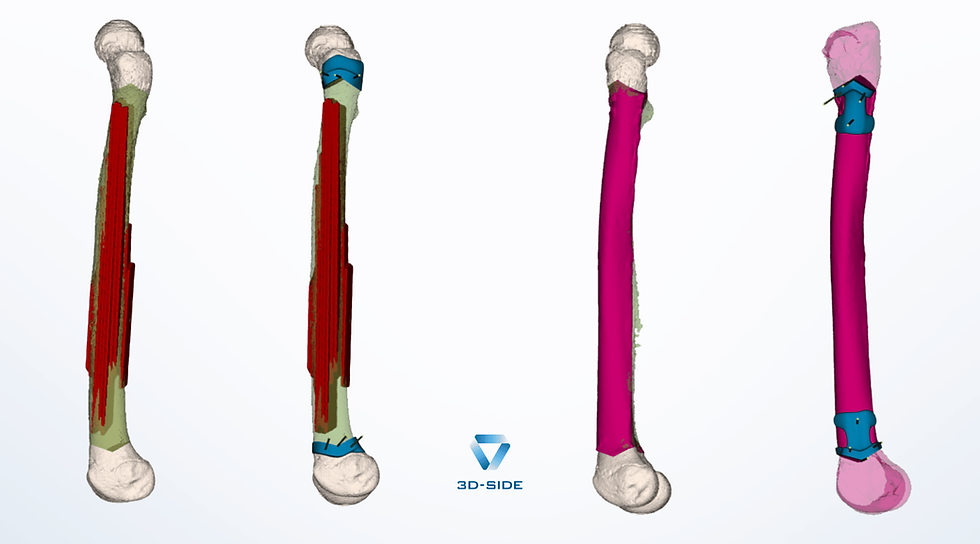
Reproducibility of the 3D planThe patient-specific 3D-CUT guide helped maintain alignment from the initial K-wire placement to the guided osteotomy, with a controlled and predictable opening. Even when the guide needed to be removed and repositioned, the surgeon could reliably return to the planned orientation.
Planning tailored to existing hardwareThe entire strategy was adapted to the Orthopediatrics blade plate, integrating an anterolateral approach for both the resection and plate alignment. This alignment between the guide, the plan, and the implant helped streamline the intraoperative steps.
More than a technical correction
While the procedure focused on restoring mechanical alignment, its impact goes further.For the patient, it means regaining mobility, reducing pain, and moving toward a more stable daily life.
And for the surgical team, it’s a reminder of what can happen when engineering and clinical practice meet with a shared goal: making the steps of the procedure feel clearer, more predictable, and more secure.


Comments