
Femoral Allograft Reconstruction: Verifying the Fit Before the Graft Reaches the OR
Resecting a bone tumor is only half the job when the plan calls for a biological reconstruction. Restoring limb continuity means the allograft has to close the gap left by the resection with matching geometry, and any mismatch is far cheaper to catch on a screen than during surgery.
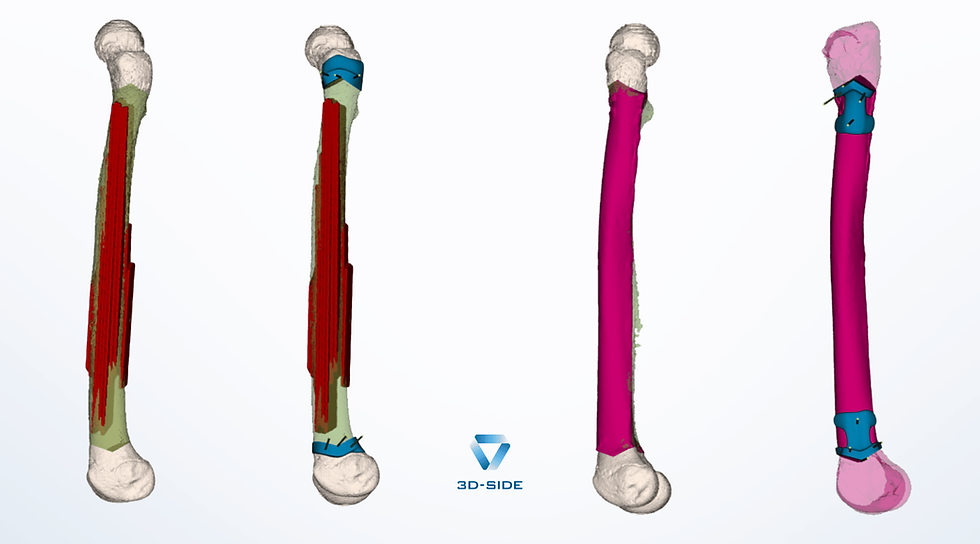
This case involved a femoral tumor requiring resection, followed by reconstruction with a bone allograft shaped to match the defect exactly. The plan combined four cutting planes arranged in a chevron pattern for reconstruction stability, a 10 mm safety margin, and a lateral approach.
One Geometry, Two Sets of Guides
Two resection guides, one proximal and one distal, cover the full extent of the planned cut. Each fits the bone in a single position, held by K-wires placed at the intersections of the cutting planes for stability across the multi-plane osteotomy.
Two more guides, built to the exact same planes, are designed for the allograft rather than the patient. Once the graft is cut to this mirrored geometry, its surfaces meet the remaining host bone directly, with no adjustment needed in the operating room.
Contact Where the Bone Doesn't Offer Much
On sections of bone with little natural relief to grip, the guides add contact surfaces beyond the ones built into the main design. These extra points are connected by breakable bridges: once the guide's position on the bone is confirmed, the bridges are cut away, leaving only the working guide in place.
Checking the Graft Before It Reaches the Patient
Once a first allograft was received from the bone bank, it was scanned and digitally overlaid onto the planned resection defect. The geometric match wasn't good enough. A second graft, better aligned with the area to reconstruct, was requested and used instead — a mismatch caught on a screen, well before it could become a problem during surgery.
Closing the Case
With the tumor resected and the graft shaped to the same planes, the two surfaces met directly, restoring the bone's continuity without last-minute adjustment. We thank the surgical team for their trust and for the precision of their feedback throughout the design process.
Facing a similar case? Contact us

Comments